
I grew up in a community that is extremely proud of its German heritage, from my family to the bilingual school that I started attending in first grade. It should come as no surprise, then, that I cut my teeth on the Brothers Grimm at a very early age. My love of fairy tales and folklore only grew as I reached adulthood, expanding from the Brothers Grimm to Perrault and beyond.
So, it is my pleasure to begin this web page in the same way that my love of stories began – with a series devoted to fairy tales. I hope you enjoy this journey – for a journey it will be – into the wild and mysterious world of storytelling.
Most of the time, stories come to us in written form, either as histories with verifiable facts or as the wonderful imaginings of fiction. But storytelling goes further back than the written word. Cave drawings throughout the world depict the migrations of animal herds and the heroic actions of hunters. My favorite is a cave painting of hundreds of hands, one on top of the other, in a show of how many people had found shelter within the confines of the cave, from full-grown adults to the very young, like being on home base in a world-wide version of survival tag.
From cave paintings, storytelling migrated to word of mouth, with each rendition changing and reforming with the telling, until the end result was far removed from its humble beginnings: a centuries-old game of telephone.
However, the Brothers Grimm took this one step further, blatantly transforming the tales they wrote down in an attempt at giving them moral significance. This can be seen throughout the three editions of Kinder-und Hausmärchen, but the one that stands out to me the most is the story of “Rapunzel.”
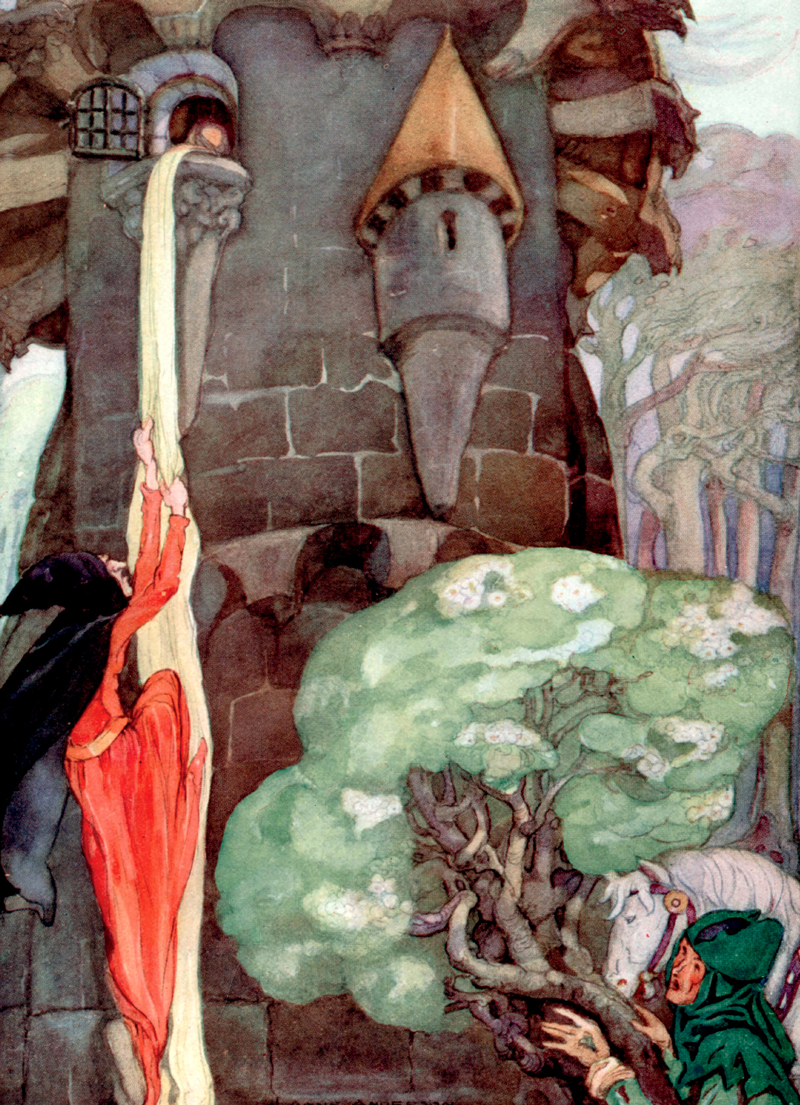
As with most folktales, there are many versions of “Rapunzel,” most centuries older than the familiar retelling set down by Wilhelm and Jacob Grimm, all of them changing with the ideas and ethics of the times in which they are written. However, the Brothers Grimm were the first to make changes to and even expanding the same stories over and over again.
There are quite a few changes to Rapunzel from its first publication in 1812 to its final entry in 1857. The first, most notably, was transforming the fairy from the original tale to a sorceress. This was to give the character a more worldly, rather than otherworldly, origin as well as to bring a Christian influence to the tale by having a so-called evil character to defeat.
However, it is not the moral character of the sorceress that is being called into question, but of the people surrounding her. After all, the story doesn’t start with the girl being in the tower, but with a young couple who are trying to have a baby. The pregnant wife is suffering from cravings and sees a garden outside her window with the most delicious-looking cabbages inside. So, she begs her husband to fetch her one. The husband agrees and sneaks into the garden. He takes the cabbage back to his wife, who eats it. After her first taste of the cabbage, the wife refuses to eat anything else. Not wanting his pregnant wife to starve, the husband goes back to the garden to steal another cabbage. This time, however, he’s caught by the fairy who owns the garden. The husband pleads with the fairy, telling her his tale of woe. The fairy allows the man to take as much cabbage as he can carry, even telling him to come back for more when his wife commands it. In return, the fairy – in true Rumpelstiltskin fashion – demands that the couple give her their child once it is born. This makes sense on a “what is yours is mine” line of logic. After all, the parents did steal from her, so it’s only fair that she take something of theirs, right?
Another rather important change to the story is how the fairy finds out that the prince has been visiting the tower. In the original tale, Rapunzel has trouble fitting into her clothes and asks the fairy why they are so tight. The fairy hears Rapunzel’s question and jumps immediately to the correct conclusion. Rapunzel was pregnant, meaning she had had a male visitor and they had been doing something rather naughty while the fairy hadn’t been looking.
In punishment, the fairy cuts Rapunzel’s hair and tosses her out to wander the woods alone. Then she waits for the prince to return and pushes him from the window. He falls face-first into a rosebush, scratching his eyes out, and spends months wandering the woods blind.
Don’t worry, though. He eventually finds Rapunzel, who cures his blindness with her tears. He opens his eyes to see her and their two children living in a cottage in the woods. He takes his family back home to his father’s kingdom and, you guessed it, they lived happily ever after.
The Brothers Grimm weren’t too keen on the unmarried teenage pregnancy story-line. Not the Christian thing to do, and all that. So, to clean it up, they have the prince ask her to marry him, which she agrees to do, and they make a plan to escape the tower. Before their intended escape, however, Rapunzel asks a thoughtless question: “Why does it take you so long to climb up the tower when the prince is so fast?” This also resulted in Rapunzel’s being shaved and tossed out on her ear and the prince wandering the woods blind. Oh, and Rapunzel still ended up having a set of twins, but that’s okay. They’re married.
I have to admit I love this story. It was one of my favorites as a girl. When Disney’s “Tangled” came out in theaters, I was ecstatic, because I finally saw my favorite character coming to life before my eyes. I know what you might be thinking. Was I really a fan of the girl locked in the tower, waiting for the prince to come and set her free? The answer is a definite “no.” While I love a good romance, it was the sorceress that interested me more, and Mother Gothel didn’t disappoint, though there is one thing about her that missed the mark.
As I said before, the sorceress is not the antagonist of the tale, but rather the moral compass. This is all too evident in the fact that she is the one giving out the punishments, not the other way around. In fact, Rapunzel is one of the few fairy tales where this is true. Grimms’ fairy tales are full of coming of age stories, such as “Iron Hans,” where the hero is given certain tasks or trials to face. If the trial is passed, the hero is rewarded. If failed, the hero is punished.
“Rapunzel” is an example of nobody learning their lesson. Rapunzel’s parents lose their first born child for stealing a head of cabbage. Rapunzel is thrown out of the only home she’s ever known for lying by omission, only to become a single mother of twins. Finally, the prince is blinded for giving in to lust. The sorceress? She’s fine. She still has her house and garden with all the cabbage she can eat.
So, when I say that “Tangled” is missing something, it is that Mother Gothel wasn’t trying to teach anyone a lesson. Mother might know best, but this mother was truly the “bad guy.”
For more of “Rapunzel”, or if you are interested in having the sorceress get her just desserts, try reading the Italian version, “Petrosinella”, by Giambattista Basile. In “Petrosinella,” the sorceress is portrayed as an ogress, who chases after the girl and the prince when they escape the tower, only to be caught in a trap of her own making.
 Book Gnome