I love Halloween. I mean, who doesn’t, right? It’s the perfect time of year to try on something new, to become someone other than yourself, if only for one night. It’s also the one time of the year that I go searching for the mysterious and mind bending stories that make Halloween so much fun.
A couple years ago, I was taking a class on romantic literature. No, not romance novels, though I’ve read my fair share. No, I mean romantic literature as in written around the turn of the nineteenth century, with writers such as William Wordsworth and William Blake.
What does this have to do with Halloween, you ask? Well, this was also the period of history when the first science fiction and horror novel was written by a nineteen-year-old Mary Wollstonecraft Shelley. That novel is, of course, Frankenstein, or the Modern Prometheus.
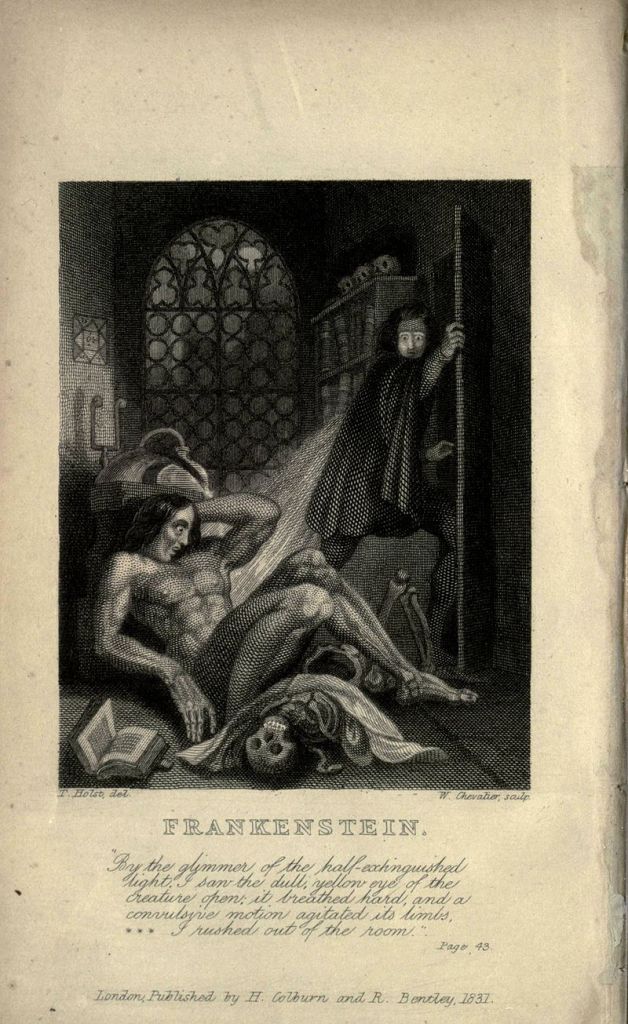
The story was ahead of its time and yet still steeped in the superstitions and myths that Mary Shelley would have grown up hearing from those people around her. In a world on the cusp of scientific discoveries and entrenched in religious fervor, Frankenstein embraced both equally; showing a world steeped in the fear of the unknown as well as the dangers of gambling with the natural order. In fact, the story is so rich in detail, that it is nearly impossible to talk about everything she brings to light without first going into her life – a feat that would require its own blogpost. Because of this, I will only be focusing on the story and its different adaptations, adding a few historical details for flavor, rather than going into detail about where she got her ideas.
Though I grew up watching Young Frankenstein, I didn’t read Shelley’s story until I enrolled in the Romantic Literature class I mentioned above. I knew, of course, that the movies I’d seen were nothing like the novel, but reading it for the first time blew my mind. While there have been many different plays, films, TV shows, and even some other books that have played around with the ideas introduced within the original novel, there are few that have shown an understanding of the core values that make up the heart of the story as it was told by Mary Shelley.
Even within Mary Shelley’s lifetime her story took on a life of its own, being produced into a short play in the 1830s – a play that was the great-grandfather of the 1931 version starring Boris Karloff as the creature – and with that play comes the more familiar Halloween characters that are known and loved today. However, the characters set down by the author are far removed from the mad scientist in his secret laboratory and the silent monster he created.
At its core, this is a story of wanting to be loved and understood. Victor von Frankenstein, a medical student nearing the end of his studies in Austria, attempts to prove that he can conquer death by bringing life to his creature by way of galvanism – at the time a brand new science using electrical currents to show that nerves can be manipulated even after death (the forerunner to a modern day EKG) – only he doesn’t understand the consequences of his actions. Most of his education was from reading old alchemy books in his father’s study before going off to university. His experiment, rather than being conducted in a laboratory on campus, took place in his own apartment away from prying eyes, because – of course – he was stealing body parts.
Side note: Ironically, at the time that this novel was being written, body-snatching was a lucrative business. The only legal way for doctors and medical students to acquire corpses was through the execution of prisoners. Many medical students were in need of practice and relied on body snatchers to find subjects to study. As a result, doctors paid a lot of money for fresh cadavers… You know, in between waiting for the next public execution.
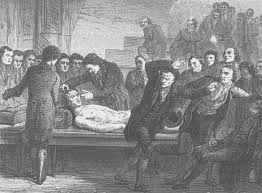
de la Science (1867)
The creature – a representation of the unknown, feared, and unnatural – is abandoned before he becomes fully developed. Now, this is not the mindless monster portrayed by Boris Karloff in 1931 or the comical loveable genius of Peter Boyle in Mel Brooks’ Young Frankenstein. These movies, while entertaining, are far removed from Shelley’s novel. Much like his creator, the creature is self-taught. Like a baby, he learns to feed and clothe himself. He teaches himself to read and he is brilliant. However, he is alone. He tries to find someone who can understand him, even approaching a blind man who can’t see that he is made out of human remains. When he can’t find a friend, he turns to rage and revenge. He searches for and finds Dr. Frankenstein and gives him a warning.
“I do know that for the sympathy of one living being, I would make peace with all. I have love in me the likes of which you can scarcely imagine and rage the likes of which you would not believe. If I cannot satisfy the one, I will indulge the other.”
Mary Shelley, Frankenstein
In a twist of fate, both creature and creator end up chasing each other across the world, neither willing to give in to the other’s demands. They become, in a sense, committed to each other in a way that brings them both closer to each other and farther from humanity.
At the same time that I was reading the novel, I went to go see a production of Frankenstein starring Benedict Cumberbatch (Sherlock) and Johnny Lee Miller(Elementary). It is one of the most true adaptations of the novel that I have had the pleasure of seeing. The fun part about this production – aside from seeing two Sherlocks on the same stage – is that when the showings were still live, the two actors would switch roles each night, one playing the doctor and the other the creature. As a result, there was a shift in how the characters were portrayed by the actors, until both creator and creature appeared the same. There are limited showings every year during the Halloween season at local movie theaters and I do recommend seeing both versions. You can find locations and showtimes at http://ntlive.nationaltheatre.org.uk/productions/ntlin4-frankenstein.
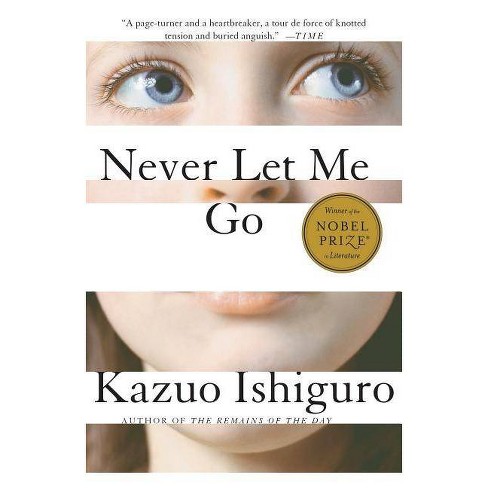
If your taste in reading is more towards the modern side, then I would suggest Kazuo Ishiguro’s Never Let Me Go. This novel definitely gives a twist to the Modern Prometheus that would earn Mary Shelley’s approval, as well as approaches the ever-growing concern that even though you have the ability to do something doesn’t mean you should. There is also a movie adaptation starring Carey Mulligan and Keira Knightley, which is pretty good. As with most things, the book is better.
 Book Gnome